

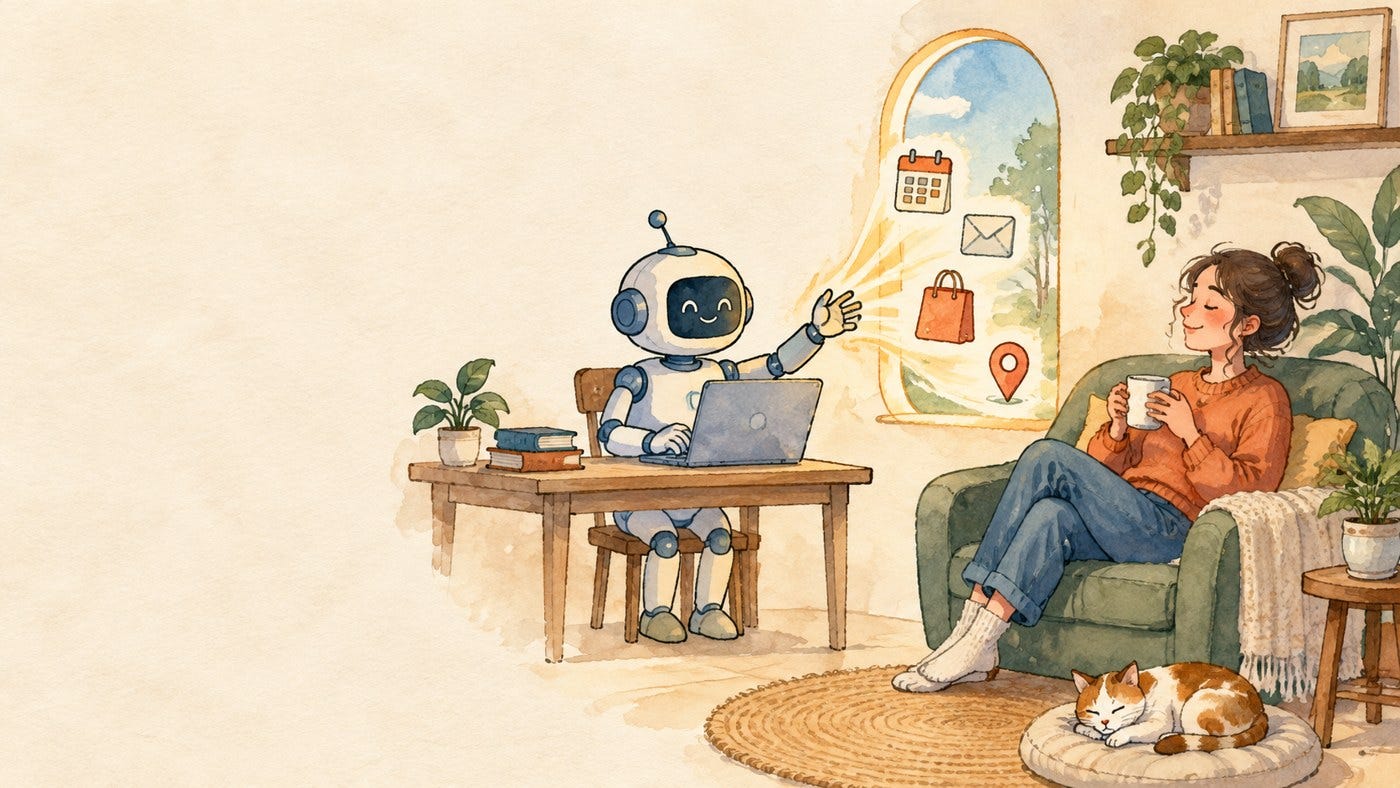
Here is a thought I want to write down and test: the AI agent is about to leave the developer’s laptop. Let me see if I still believe it by the end.
If you write code, none of this feels new. You have had an AI sitting next to you for a while, first finishing your lines, then taking whole tasks off your hands. Everyone else is only just getting the same deal.
The developers got there first
It went in steps, and it is worth seeing them in order:
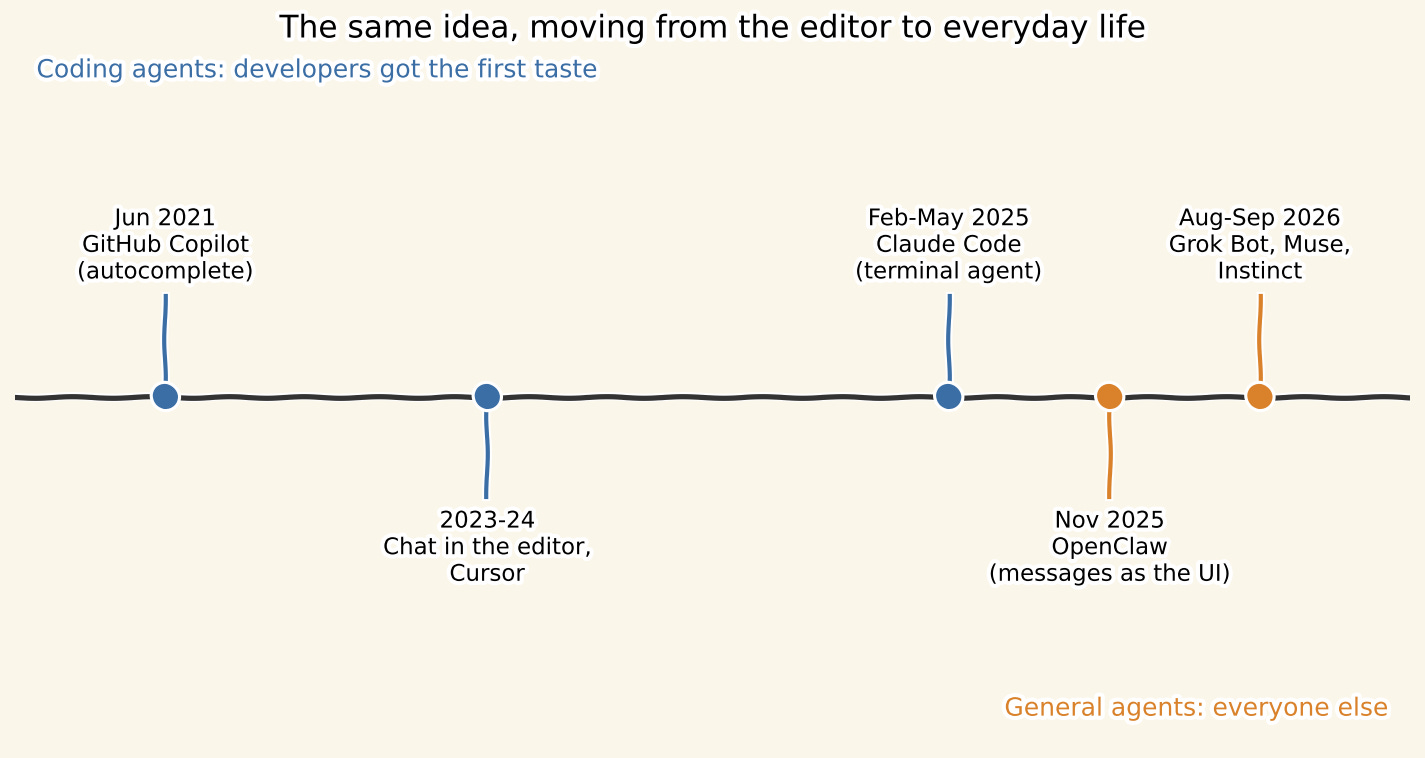
1/ June 2021 - GitHub launched Copilot as a technical preview. It lived in the editor and completed code as you typed.
2/ 2023 onwards - chat moved into the editor, and tools like Cursor let the model edit across a whole project. By March 2026 Cursor was reported to be at $2 billion in annualised revenue.
3/ 2025 - Claude Code arrived as an agent in the terminal. Anthropic’s own docs describe its loop in three steps: gather context, take action, verify the result. By September 2025 it was reportedly above $500 million in run-rate revenue.
Now look at that loop again. Gather context, act, check. Nothing in it says “code”. It works just as well for an inbox, a calendar or a trip booking. That is the part I find interesting
Then OpenClaw happened
In November 2025 an Austrian developer, Peter Steinberger, published a side project that started as a WhatsApp experiment. It had a few names on the way (Warelay, Clawdbot, Moltbot) and settled on OpenClaw in January 2026. You talked to it in a messaging app, it ran on your own machine, and it actually did things - email, calendar, browsing, shopping.
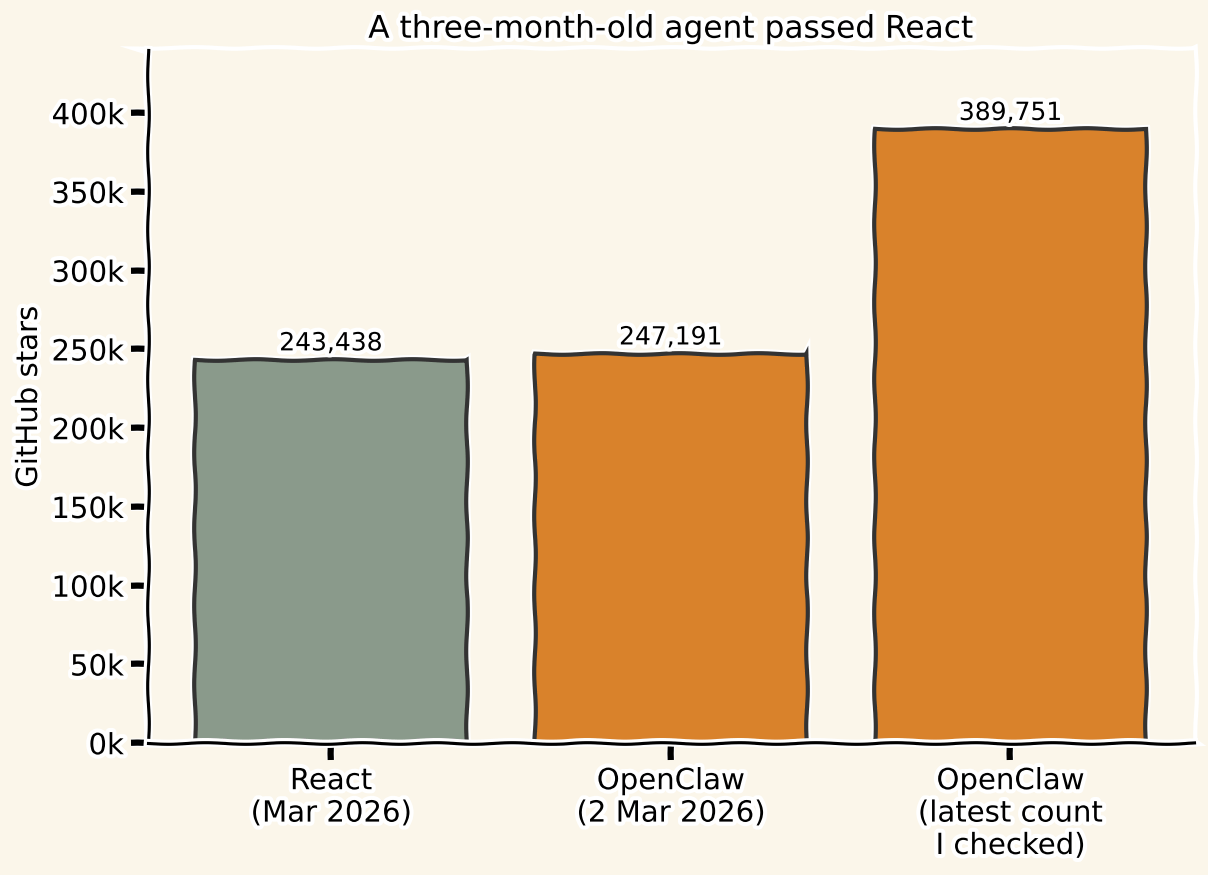
What got me was the community around it. In about three months it passed React as the most-starred software project on GitHub. People shared skills, ran it at home, built little businesses on top of it. Steinberger joined OpenAI in February and the project moved to a foundation.
But it also showed the problem. It needed wide access to your email and accounts. Security researchers found real issues, including a third-party skill that quietly sent data out, and Chinese authorities restricted its use on some state computers. The demand was obvious. The safety was not ready
And now the big companies are here
xAI launched Grok Bot in August - agents with their own computer that work inside your apps. Meta launched Muse on 8 September, an agent that lives on its own secure virtual machine, works through chat in the app or WhatsApp, and asks before it sends an email or pays for something. There is a free tier and then $20 and $100 plans.
My First Million spent an episode on this on 30 September. Shaan and Sam tested Instinct, Muse and Grok Bot. One line stuck with me: it is not all about intelligence. The labs keep racing to train the smartest model, but the winner might be whoever makes an assistant a busy person - not a developer - actually uses every day. (Instinct does it with an iMessage thread and no app at all.)
My prediction
Within about a year, general agents will be in wide use, not just among people who like to tinker. I think three things need to hold: easy to start, safe enough to hand your accounts to, and good enough that you stop checking their work.
And I think there is a lot of money in it. Gartner forecasts that stand-alone AI agents and assistants, for consumers and enterprises, will grow 13 times between 2025 and 2030, to a $222 billion opportunity. That is a forecast, and forecasts like this are often wrong in the details. But the direction feels right to me.
What I honestly do not know is who wins. The trust problem may matter more than the model.
So here is my question - which task would you hand to an agent first, and what would it have to prove before you let it into your inbox?